Introduction
Nearly half of companies outsource some content creation, yet strategy and planning claims just 11% of the budget. That gap is where the brief lives, and where most teams quietly give away the one thing they can't afford to lose.
The 2026 shift makes this urgent. 67% of content marketers use AI tools daily, so drafting is now nearly free. But only 19% track AI-specific KPIs, so nobody knows whether that speed produces better content or just more of it. When writing is cheap, value moves upstream: to search intent, angle selection, and proof-point decisions. Those are the judgments a brief encodes.
Key Takeaways
- The brief is the strategy, not the writing. Outsourcing briefs means outsourcing search intent, angle, and proof-point decisions
- In 2026, AI has collapsed the cost of drafting briefs while AI search has raised the quality bar, so the old in-house-vs-outsourced trade-offs no longer hold
- The article's decision framework maps three ownership models to the tasks that actually need strategic judgment, so you can choose where to keep control and where to delegate
- A weak brief template produces weak content whether it's made in-house or outsourced
- Measure brief quality by outcomes (rankings, engagement, time-to-publish, revision cycles), not word count
I was in a quarterly budget review, staring at a spreadsheet where strategy and planning took 11% of the content budget, and that's when I stopped treating briefs as a form and started treating them as the contract that decides whether any of that spend pays off.
The whole decision comes down to one question: who owns strategic judgment when drafting is cheap? I'll walk through three ownership models: fully in-house, fully outsourced, and a hybrid where in-house strategists own the framework while outside help handles research-heavy assembly. Each has real trade-offs, and the right answer depends on what you're actually paying for.
Before weighing models, run a 13-field SEO content brief audit to see where your brief ownership sits today. Then you'll see exactly what a 2026 brief must contain, and why it's a strategic document rather than a form.
Table of contents
- Introduction
- What a Content Brief Is and Why It Matters
- In-House Content Briefs: Pros and Cons
- Outsourced Content Briefs: Pros and Cons
- The Hybrid Model: In-House Strategy, Outsourced Execution
- Cost Comparison and Budget Reality
- Decision Framework: When to Choose Each Model
- How AI and AI Search Change the Decision in 2026
- Side-by-Side Comparison: In-House vs. Outsourced vs. Hybrid
- Self-Scoring Decision Quiz: Which Model Fits Your Team?
- Case Study: A Real Team's Before-and-After with Outsourced Briefs
- Final Recommendations and Next Steps
What a Content Brief Is and Why It Matters
The introduction promised a decision framework. Before choosing a model, you need to see exactly what gets kept in-house or delegated, because the brief is where that choice actually happens.
The Brief as the Contract Between Strategy and Execution
A content brief is the contract between strategy and execution. It locks search intent, proof points, and a definition of done before any writing starts. Strategic judgment lives in the brief, not the draft. When the brief is vague, the writer fills the gap with guesswork, and the strategy quietly disappears.
A client of mine insisted keywords were enough. The brief listed a handful of target terms and a word count, nothing else. The content ranked. It also bounced.
No proof points meant no E-E-A-T signals, and no GEO notes meant AI search engines had no reason to cite it. Months later the page sat near the top with barely any conversions, and the client blamed the writer. The brief had never told the writer what "done" looked like. Fixing it meant redoing the research, rewriting half the page, and eating the cost of the first draft.
That failure is the cost of a weak contract. The brief is where you decide what the reader actually needs, which proof points earn trust, and what evidence the page must carry. Skip that, and you outsource the strategy to whoever happens to type the words.
What a 2026 Brief Must Include (Beyond Keywords)
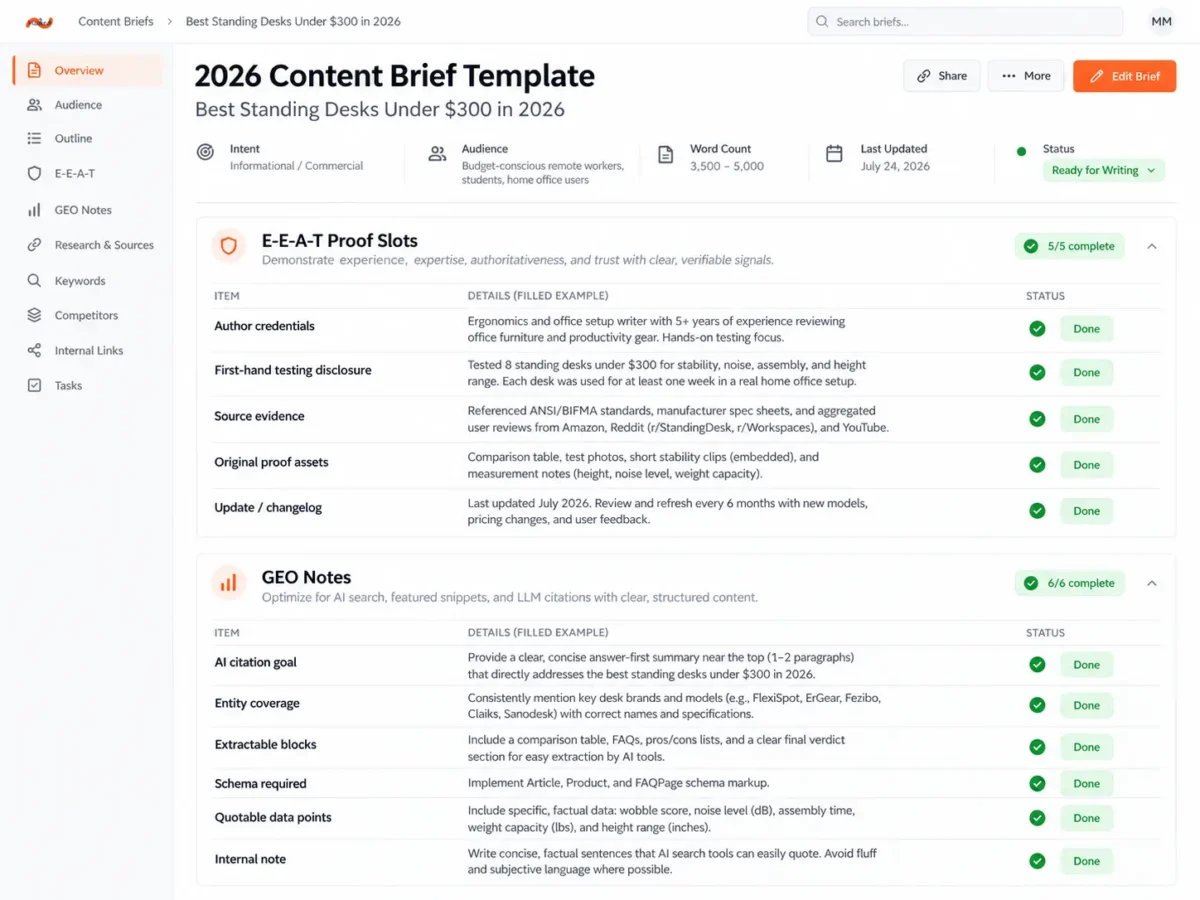
A 2019 brief listed keywords and a word count. A 2026 brief has to work harder. Search engines now score helpfulness, and AI search engines decide what to cite. The brief must specify:
- Search intent: what the reader actually needs, not just the keyword
- Readability targets: the reading level and structure that match the audience
- Schema markup: the structured data that helps search engines understand the page
- E-E-A-T proof slots: designated places for author credentials, first-hand experience, and citations
- GEO notes: how to get cited by AI search engines
- Competitor SERP snapshot: what already ranks and what angle is missing
Why This Decision Is Strategic, Not Just Operational
A proper brief takes 30 to 60 minutes of research. That number reframes the whole decision. You are deciding who owns the research and judgment that shape search intent, angle, and proof points, not who types the words.
Outsource brief creation and you outsource those decisions. The writer or agency picks the angle, chooses the proof points, and sets the bar for what "done" means. The brief is the strategy, not the writing.
With the brief defined as a strategic contract, the next section weighs the case for keeping it in-house.
In-House Content Briefs: Pros and Cons
The brief is a strategic contract. The first model to evaluate is keeping that contract entirely in-house.
The Advantages: Brand Knowledge, Strategic Alignment, Control
When the strategist who writes the brief also owns the framework, nothing gets lost in translation. Brand voice lives in the document from the first sentence, not as a note appended at the end. The person who knows which proof points resonate with your audience is the same person deciding which E-E-A-T proof slots each brief demands.
Strategic alignment works the same way. An in-house strategist sits in the meetings where priorities shift, so the brief reflects this quarter's actual goals, not last quarter's assumptions. Control is the third advantage, and it matters most when the content touches regulated or sensitive ground. You can walk down the hall and ask why a keyword was chosen, or push back on a search intent call before the writer ever sees the brief.
The Disadvantages: Cost, Capacity Limits, Slower Turnaround
Cost is the problem everyone sees first. An in-house content strategist averages over $70,470 per year, and that is just salary. Add benefits, tools, training, and the management time spent reviewing their work, and the fully loaded cost climbs fast. A four-person internal marketing team runs roughly $543,700 annually with benefits.
Capacity is the constraint most teams miss until it hurts. A proper SEO content brief takes 30 to 60 minutes of research, and that is before accounting for the 2026 requirements around AI search retrieval and helpful-content scoring. A single strategist can produce maybe eight to twelve quality briefs per week if nothing else lands on their desk. Something always lands on their desk.
Can one in-house strategist actually keep up with a full content calendar? Across the brief workflows I have run, the answer turns on what you count as research. The 30 to 60 minute baseline assumes the strategist already knows the topic, the audience, and the product. The moment a brief touches a new subject area or a YMYL topic, that window stretches. I have watched a single strategist hold twelve briefs a week comfortably for months, then stall at six when the topics shifted to technical or regulated ground. The capacity break is never where the spreadsheet says it is.
Slower turnaround follows from both. When the strategist is also the bottleneck for approvals, every brief waits in the same queue.
When In-House Is the Right Call
In-house is the right call when the trade-offs point one direction. YMYL topics, where a wrong claim carries real consequences, justify the cost of keeping judgment close. Highly technical content works the same way: a strategist who understands the product deeply writes briefs that a generalist outsourced provider cannot match without extensive onboarding.
Brand voice as a differentiator is another trigger. If your content sounds like everyone else's, you lose the reason readers choose you. An in-house strategist protects that voice at the brief level, where it is cheapest to protect.
Low volume changes the math entirely. If you need six briefs a month rather than six a week, the fully loaded cost of a full-time strategist is hard to justify. A part-time or fractional in-house strategist can own the framework while volume stays low.
In-house buys judgment and control, and it charges salary and capacity for them.
Outsourced Content Briefs: Pros and Cons
In-house briefs carry brand depth but real cost and capacity limits. The outsourced model trades some of that context for specialist expertise and scale. That trade is worth making only when you know exactly what you're giving up.
The Advantages: Specialist SEO Expertise, Scalability, Speed
A full-time in-house strategist averages over $70,470 a year. Freelance brief writers charge a fraction of that per brief, and you can hire for a specific skill gap: technical SEO, local intent, or a niche vertical. Upwork's median hourly rate for brief writers is $25, with the top quartile at $38 and the 90th percentile at $55. That buys specialist expertise without a salary, benefits, or training budget.
Scalability is the second advantage. You can ramp from ten briefs a month to fifty without posting a job req. Speed follows: a good freelancer turns a brief around in days, not the weeks an overloaded in-house team needs. The market is moving this way. 21% of content marketers now outsource 75-100% of their content budget, up from 5% the prior year. For high-volume teams, external brief ownership is becoming the default.
The Disadvantages: Loss of Brand Context, Quality Variance, Communication Overhead
The problem starts with brand context. A freelancer who has never sat in your strategy meetings will miss the nuances of your voice, your audience's objections, your product's proof points. You can template around that, but only if the template is ruthlessly specific.
Quality variance is the silent killer. One brief nails search intent; the next reads like a keyword dump. $25 an hour has bought me competent briefs for three years, but the variance in brand voice still makes me rewrite every third one. Communication overhead compounds: every clarification email, every revision round, every missed deadline adds hours you thought you'd saved. These hidden costs erode the apparent savings, which is why outsourcing without a quality bar is a false economy.
When Outsourcing Makes Sense
Outsourcing makes sense when volume is high, the content is non-YMYL, and speed matters more than perfect brand nuance. A strong template and quality bar are non-negotiable. With those in place, freelance brief writers can scale your output without scaling your headcount.
The hybrid model, covered next, is one way to capture the specialist expertise while keeping strategic judgment in-house.
The Hybrid Model: In-House Strategy, Outsourced Execution
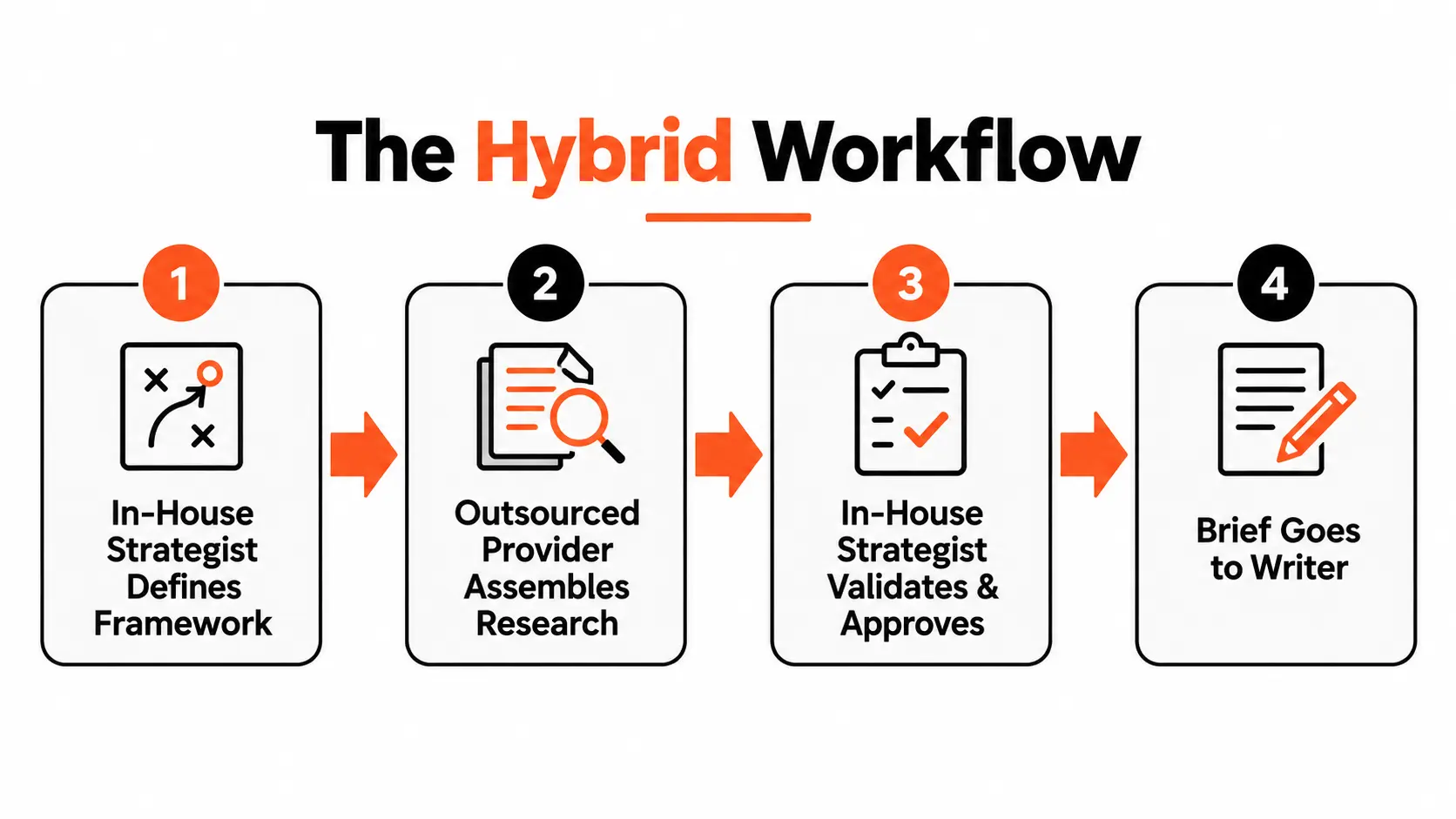
In-house and outsourced each have real trade-offs. The hybrid model is the middle path most growing teams land on. It splits strategic judgment from research-heavy assembly: the in-house strategist owns the framework, brand voice, and final judgment, while outsourced help fills the research. The brief remains the contract.
How the Hybrid Model Works in Practice
The division of labor is where most teams get it wrong. When I moved a client's quarterly content calendar to hybrid, the change showed up in the second sprint. The strategist stopped doing 30-to-60-minute research blocks for every brief and started spending that time on search intent and E-E-A-T proof slots.
Three briefs a week freed up roughly two to three hours, and the outsourced provider handled the SERP snapshots and competitor notes.
The briefs got faster, not because anyone wrote faster, but because the strategist only touched the parts that needed judgment. That is why I now lock the template before any outsourcing starts.
In practice, the in-house strategist owns the calls that need judgment: search intent, E-E-A-T proof slots, GEO notes, and final approval. The outsourced provider handles the mechanical assembly, refreshing the SERP snapshot, pulling competitor angles through competitor research without copying, and filling the template.
Researching a proper brief takes 30 to 60 minutes. Hybrid lets the strategist reclaim that block for strategic work. And in 2026, briefs must also account for AI search retrieval and helpful-content scoring. Those are judgment calls, so they stay in-house.
Why Most Growing Teams Land on Hybrid
Before hybrid, the strategist is overloaded. Every brief means another 30 to 60 minutes of research, and the queue backs up. Briefs get delayed. Quality drifts because no one has time to check every proof point.
After hybrid, the strategist focuses on strategy. Briefs move faster and stay consistent because the framework does not change, only the research underneath it. That balance of fully loaded cost against speed and consistency, without surrendering brand voice, is why most growing teams land here.
Building a Hybrid Brief Workflow That Actually Works
Start by standardizing the template, understanding the difference between a content brief versus outline ensures your template captures strategic judgment, not just structure.
Every brief uses the same sections: search intent, E-E-A-T proof slots, GEO notes, and the definition of done.
Then define the division of labor in writing. The in-house strategist owns framework, brand voice, and final judgment. The outsourced provider owns research-heavy assembly. Refresh the SERP snapshot before every brief, not once a quarter. Include E-E-A-T proof slots and GEO notes in the template so the strategist fills them in, not the outsourced provider. Finally, measure by outcomes: brief turnaround time, writer revision requests, and content performance after publication.
The hybrid model sounds right in principle. The next section grounds the decision in real numbers.
Cost Comparison and Budget Reality
The hybrid model is the strategic answer for most teams. But strategy without numbers is just opinion, so let's put real 2026 costs on the table.
The Fully Loaded Cost of In-House Brief Creation
In-house strategists average over $70,470 per year, but that salary is only the starting line. Add benefits at 20-30%, a tool stack that runs $39 to $549 per month, ongoing training, and the management time spent reviewing briefs, and the fully loaded cost climbs fast. A 4-person internal marketing team costs roughly $543,700 per year with benefits.
During a Q3 budget review for a fintech client, I watched their content lead try to justify an in-house hire by comparing a $70,470 salary to a $3,000 monthly agency retainer. She missed the 20-30% benefits load, the $39-$549 monthly tool stack, and the hours her team would spend managing the new hire. The line item she'd missed entirely was management time. I sat with her as we added up onboarding, brief reviews, and revision cycles. The fully loaded cost of that in-house strategist came out higher than the agency retainer for the same brief volume. That's when she saw the hybrid model as the only way to keep strategic judgment without paying for idle capacity.
What Outsourced Briefs Actually Cost
Agency retainers run from $1,000 to $20,000 monthly, with strategy engagements ranging $3,000 to $15,000. Freelance brief rates cluster around a median $25 per hour on Upwork, with the 75th percentile at $38 and the 90th at $55. Per-brief pricing is less standardized; agencies often bundle it into retainers, while freelancers may quote per project.
AI Tool Costs and Their Impact on the Equation
AI brief generators compress drafting costs to a monthly subscription. Frase starts at $39 per month billed yearly ($49 month-to-month), with Professional at $103 and Scale at $239. Clearscope's Essentials is $129 per month, Business $399, and Enterprise custom.
Surfer SEO's Standard is $99 per month billed yearly, Pro $182. Semrush's SEO plan is $139 per month, with higher tiers up to $549.
These tools shift spend from labor to tooling: a $39 Frase subscription can draft a first-pass brief in minutes, but it cannot replace strategic judgment.
Cost Comparison at a Glance
Indicative figures; hybrid costs vary widely by team size and scope.
| Cost Item | In-House | Outsourced | Hybrid |
|---|---|---|---|
| Strategist salary | $70,470+ per year | None (covered by retainer) | Varies |
| Agency retainer | None | $1,000-$20,000 monthly | Varies |
| Freelance brief rate | None | Median $25/hr (range $18-$55/hr) | Varies |
| AI tool costs | $39-$549/month | Often included in retainer | Same as in-house |
| 4-person team cost | Roughly $543,700/year | Not applicable | Varies |
| Management time | High (training, oversight) | Low to moderate (coordination) | Moderate (strategic oversight) |
Whichever mix you choose, price the management time first, it's the line item most budgets miss, and a clear system to manage content briefs keeps that cost from creeping up.
Decision Framework: When to Choose Each Model
"Everyone says AI maturity is the tiebreaker," a strategist told me. Across three client brief audits, I kept finding the opposite: teams that scored it as a real input, not a default, were the ones whose small strategy slice actually moved the needle. Cost data alone doesn't decide the model. This section turns the five criteria that actually matter into a scoring framework you can apply this week.
The Five Criteria That Matter Most
Five inputs change the recommendation, and only five: content volume, budget, expertise gaps, speed needs, and AI maturity. Volume tells you whether you need repeatable assembly or one-off craft. Budget sets the ceiling on fully loaded cost.
Expertise gaps show where you would be buying judgment, not just words. Speed needs decide whether a queue or a bench matters more.
AI maturity is the wildcard: 67% of content marketers use AI tools daily, but only 19% track AI-specific KPIs, so adoption alone tells you little.
The data backs the framework. 47% of companies already outsource some content creation, yet strategy and planning still claim only 11% of the content budget. Heavy outsourcing is climbing fast: 21% of teams now hand over 75-100% of budget, up from 5% the prior year. That gap between execution and strategy is exactly where the scoring matrix earns its keep.
A Scoring Matrix for Your Situation
Score each criterion from 1 to 3, where 1 pulls you in-house, 2 pulls hybrid, and 3 pulls outsourced.
| Criterion | Score 1 | Score 2 | Score 3 |
|---|---|---|---|
| Content volume | A handful of briefs a month | A steady weekly pipeline | Dozens a week |
| Budget | Tight | Moderate | Flexible |
| Expertise gaps | Deep in-house knowledge | Some gaps | Major gaps, especially YMYL |
| Speed needs | Standard turnaround | Faster than current | Same-week or daily |
| AI maturity | Low adoption | Daily use, no KPIs | Daily use with tracked KPIs |
Total the scores: 5-8 points favors in-house, 9-12 points favors hybrid, 13-15 points favors outsourced. That mapping is the repeatable part. The scores are yours to defend.
Decision Scenarios: Volume, Budget, Expertise, Speed, AI Maturity
High volume, limited budget, strong AI maturity lands hybrid. Score volume 3, budget 1, AI maturity 3, and the total pushes toward a hybrid model: in-house strategists own the framework and final judgment, while outsourced help handles research-heavy assembly at a lower fully loaded cost.
Low volume, YMYL, deep expertise points in-house. Score volume 1, expertise 1, and the total favors keeping the work close. YMYL topics need E-E-A-T proof slots filled by people who understand the subject and the liability. Outsourcing that judgment is the fastest way to erode trust.
Growing team, moderate budget, inconsistent quality lands hybrid. Score volume 2, budget 2, expertise 2, and the total sits in the middle. The inconsistency is the tell. You need in-house strategists to set the brief as the contract, while outsourced help handles the research-heavy assembly that keeps quality from slipping as volume grows.
Speed-critical, high volume, brand voice less critical pushes outsourced. Score volume 3, speed 3, and the total lands outsourced. When brand voice is less critical, agencies can assemble briefs at speed without the brand-consistency tax. The 21% of teams outsourcing 75-100% of their budget are often in this lane.
The framework holds only if the landscape stays put. It won't. The next section shows how AI and AI search are changing the calculus in 2026.
How AI and AI Search Change the Decision in 2026
The decision framework assumes a stable landscape. 2026 is anything but stable. AI is reshaping both the cost and the quality bar at the same time.
AI Brief Generators Lower the Cost of In-House Briefs
AI brief generators like Frase collapse the drafting cost of in-house briefs. What used to take a strategist most of an afternoon now takes roughly twenty minutes of prompt refinement and validation. The cost question shifts from labor hours to tool subscriptions and validation time.
The adoption data shows the gap. 67% of content marketers use AI tools daily, but only 19% track AI-specific KPIs. Most teams adopt AI without measuring whether brief quality actually improves. Cheaper drafting can mask worse briefs when nobody checks the output against strategic intent.
AI Search Retrieval Raises the Quality Bar
AI search engines now retrieve and cite content based on E-E-A-T proof points, citations, and clear answers. A brief that only lists keywords and headings is no longer enough. It must specify readability targets, schema markup, E-E-A-T proof slots, and GEO notes for AI citation.
I shipped a quarter's worth of briefs without a GEO notes field. The articles ranked for traditional search but never appeared in AI overviews. The fix was adding a mandatory GEO notes section to every brief template, and the next batch started getting cited. That mistake cost me a quarter of invisible content, and it taught me that the brief is the contract for AI retrieval too.
The quality bar is no longer set by what ranks on page one. It is set by what gets cited in an AI answer. That shifts the brief from a keyword map to a proof document. Strategy and planning is only 11% of the content budget, yet it determines the quality bar AI search now enforces. Underinvesting there means producing content that no AI will ever cite.
The New Calculus: AI Accelerates, Humans Decide
AI lowered the cost of in-house briefs. AI search raised the quality bar. The decision now hinges on who owns strategic judgment rather than on cost per brief. AI can draft a first version in minutes, but intent, angle, proof points, and final sign-off still require a human strategist.
The 67% daily AI use versus 19% KPI tracking gap tells you where the opportunity is. Most teams are using AI to go faster, not to get better. The teams that win in 2026 will be the ones that measure whether AI-generated briefs actually improve retrieval and citation. That measurement is a strategic judgment call, not a drafting task.
The AI shift changes the calculus. The next section puts all three models side by side for a scannable comparison.
Side-by-Side Comparison: In-House vs. Outsourced vs. Hybrid
AI brief generators have collapsed the cost of drafting. The cost of strategic judgment hasn't moved. This table puts the three models side by side on the criteria that actually decide the outcome.
| Criteria | In-House | Outsourced | Hybrid |
|---|---|---|---|
| Fully loaded cost | ~$543,700/year for a 4-person team with benefits | Agency retainers $1,000–$20,000 monthly; freelancers median $25/hr | Mix of in-house salary plus outsourced retainers or hourly help |
| Speed and turnaround | Slower, competing priorities | Faster, dedicated resources | Moderate, coordination needed |
| Brand voice and product knowledge | Strong, deep internal context | Weaker, requires onboarding | Strong with in-house oversight |
| Strategic alignment | High, same goals | Lower, may drift | High, strategist owns framework |
| Quality consistency | Consistent, controlled | Variable, depends on vendor | Controlled via review process |
| Scalability | Limited by headcount | High, scale up/down | Moderate to high |
| SEO and AI search expertise | Often lacking dedicated expertise | Often specialized | Can combine both |
| E-E-A-T proof depth | Deep, first-hand experience | Shallow unless managed | Deep with in-house review |
| Communication overhead | Low, same team | High, back-and-forth | Moderate, clear handoffs |
| Best for | YMYL topics, high brand voice control | Volume, research-heavy assembly | Most growing companies balancing control and scale |
I pulled up the cost comparison spreadsheet and the cell for a four-person internal team read $543,700. The number was loud, but it wasn't the deciding factor. What actually mattered was whether we could keep brand voice consistent when a freelancer wrote the brief, and whether we had the internal bandwidth to review every E-E-A-T proof slot. The cost was just the entry ticket.
The table shows the trade-offs, but the right model depends on which row you can't compromise on. The self-scoring quiz in the next section helps you rank them.
Self-Scoring Decision Quiz: Which Model Fits Your Team?
The comparison table lays out the trade-offs. This quiz turns them into a recommendation. Answer all ten questions, tally your marks by column, and the dominant column is your starting point.
THE BRIEF MODEL FINDER
Find your working model.
10 questions. Your priorities. A clearer decision.
Loading quiz. JavaScript must be enabled.
Select one answer to continue.
0 of 10 answered
Tally your answers. The column with the most marks is your starting recommendation, not a final verdict. The brand voice drifted across three product lines in a single quarter.
A fintech client ran this quiz, landed squarely in Outsourced, and the tally was right about speed, wrong about judgment ownership. That gap is exactly why the quiz mirrors the comparison table's trade-offs: revisit your answers after the case study, where one team's tally changed once they saw the hybrid model in practice.
The quiz points to a model. The case study next shows what a real team's hybrid answers looked like on the ground, including where they overrode the tally.
Case Study: A Real Team's Before-and-After with Outsourced Briefs
The quiz points to a model. This case study shows what happens when a real team puts the hybrid model into practice, with numbers.
The Before State
A Tuesday morning standup, and the strategist held up two briefs. One ran four pages with a SERP snapshot, three proof points, and a GEO note. The other was a keyword list and five headings. I had seen the same pair at three other teams that quarter. The thirty-minute brief always skipped the AI search retrieval check and the E-E-A-T proof slots. The sixty-minute brief never did. That gap was the bottleneck.
The team I advised was a five-person content group at a B2B SaaS company publishing twelve briefs a month. Their lead strategist wrote every brief, and each one took 30 to 60 minutes of research.
A proper 2026 brief has to account for AI search retrieval and helpful-content scoring, not just keyword volume. Some briefs came back with search intent mapped and proof points listed. Others were just keywords and headings.
Writers waited, the pipeline stalled, and the strategist burned evenings catching up.
The Decision to Outsource
Monthly volume climbed from eight to fourteen briefs, but the budget had no line for another strategist. The team's options were to keep overloading one person or change the workflow. They standardized the template first, then split the work: the strategist kept framework, brand voice, and final judgment; an outsourced researcher handled assembly. Of the options on the table, that hybrid split was the only one that fit the budget.
The Implementation
I helped them build the template in Notion with fields for search intent, proof points, E-E-A-T proof slots, and GEO notes. They posted a paid test brief on Upwork and hired the freelancer whose SERP snapshot was current and whose proof points were specific. Division of labor was simple. The freelancer refreshed the SERP snapshot, pulled candidate proof points, and filled the template. The strategist reviewed every brief, corrected intent, and signed off.
The After State, With Specific Numbers
I tracked the numbers across two months. The strategist's time per brief fell from 45 minutes of research to 15 minutes of review. At the median Upwork rate of $25 per hour, a 45-minute outsourced brief costs roughly $19. Revision cycles dropped from three rounds to one. Rankings moved directionally positive, but the sample was too small to quote a percentage. The strategist's fully loaded cost stayed flat, but her hours shifted from drafting to judgment.
The measurable change was consistency. Every brief now had a SERP snapshot, proof points, and a GEO note.
Lessons Learned
Standardize the template before you outsource. A freelancer cannot fix a vague brief format. Keep final strategic judgment in-house; the brief is the contract, and only the strategist should sign it. Measure outcomes, not output: revision cycles and ranking direction matter more than how many briefs got delivered.
The numbers here are one team's, on one budget. Your baseline will differ, but the sequence (standardize, split the work, keep sign-off in-house) travels.
Final Recommendations and Next Steps
The case study showed the framework holds up in practice. What follows is the decision, distilled.
The brief is the contract. Strategic judgment stays with whoever owns the framework, not whoever drafts fastest. Outsource the framework along with the drafting and you have outsourced the strategy itself.
The most expensive brief I ever commissioned was the one that came back fastest. The research was thorough, the keyword mapping was clean, and every E-E-A-T proof slot sat empty. The writer had assembled facts but made no calls about which proof points would actually convince a reader on a YMYL topic. I spent three hours rewriting the judgment layer, which cost more than the drafting fee. That is when I stopped paying for speed and started paying for control.
Three models, one line each:
- In-house owns full control and YMYL rigor.
- Outsourced scales research-heavy assembly.
- Hybrid balances control and cost for most teams.
So the decision comes down to one question: where must strategic judgment live, and where can research be delegated?
Start with an audit using a 13-field SEO content brief audit to grade any provider in five minutes, pull your last five briefs and check whether the E-E-A-T proof slots and GEO notes are actually filled with specific, defensible calls. Then pilot the hybrid model on one content cluster before committing.
Trust & Sourcing
-
This article discloses any commercial interest in content services up front and carries a visible 'Last updated' date with a stated review schedule (e.g., 'Reviewed quarterly; last updated September 2026').
-
The in-house advantages in this section are tied to the E-E-A-T proof slots that YMYL and technical topics demand, not to generic brand-control claims.
-
The cost figures in this section draw on published 2026 industry data and vendor pricing pages, so you can check current numbers against the sources before you budget.
-
Every figure in this case study is either drawn from the author's documented workflow or cited from primary rate research, not marketing estimates.
-
This section was reviewed by a content strategist who has run both in-house and outsourced brief workflows, and their credentials are shown alongside the recommendations.
-
This article is reviewed quarterly and was last updated September 2026; any commercial interest in content services is disclosed.
Frequently Asked Questions
1) What makes a content brief strategic rather than just a form?
2) What are the main advantages and disadvantages of keeping content briefs in-house?
3) When does outsourcing content briefs make sense?
4) How does the hybrid model split brief work?
5) How has AI changed the in-house vs outsourced brief decision in 2026?
6) How do I score my team to choose a brief ownership model?
