Introduction
You've read five competitor articles, exported a gap report, and now you're staring at a blank document. The cursor blinks. You know what they said. You're not sure what you say.
Key Takeaways
- Competitor research is legitimate when you extract strategy, the brief, angle, and gaps, not words
- Separate search competitors from business competitors before you start, or your analysis benchmarks against the wrong sites
- A gap is only real if you could credibly write a better page than what currently ranks
- The Reverse Brief method turns competitor insights into an original outline by design, not by checking at the end
- Run a self-check before publishing: if a reader could tell which competitor inspired your draft, revise the angle
The Problem: You're Not Copying, But You're Not Original Either
The fear isn't that you'll paste a competitor's paragraph verbatim. You know better than that. The fear is subtler: after enough research, your draft inherits their skeleton. Same section order, same evidence, same conclusions, just rephrased in your voice. I hit this wall on a SaaS pricing guide last spring: three sources deep, outline "done," and when I lined my draft next to the top-ranking piece, the section headings matched almost one-to-one.
I'd extracted their structure and called it research. That was the breaking point. I stopped outlining from their article and started reverse-engineering the brief they must have been working from, then wrote a better one. The distinction matters because Google's helpful content guidance, updated as recently as October 2026, assesses main content on four attributes: effort, originality, talent or skill, and accuracy.
A rephrased version of someone else's structure fails on at least two of those before you even get to the writing.
The Agitation: What Happens When You Get It Wrong
Derivative content fails quietly. It doesn't rank, because Google's people-first principles, still central in 2026, reward genuinely useful, original content with real-world experience and de-emphasize content made to manipulate rankings. It doesn't get cited by AI search tools like ChatGPT or Perplexity, which surface distinct perspectives rather than the consensus average. And it doesn't build reader trust, because a reader who has seen the top three results can sense when your article is the same ideas in a different font.
The root cause is almost always the same extraction error. You extracted words instead of strategy. You copied structure instead of angle. You cataloged topics instead of identifying gaps. Those are three different mistakes, and fixing them requires three different habits, not just more willpower to be original.
The Solution: Strategy Extraction, Not Copying
Strategy extraction means understanding a competitor's underlying strategy: their angle, their structure, their evidence, their gaps. You reverse-engineer the brief they must have used, then write a better one for your own angle. The words never come with you. The analysis does.
This guide walks through the full process: a repeatable workflow that turns competitor signals into an original brief, a prioritization framework for deciding which gaps are worth filling, and a self-check you run before publishing that catches derivative work before it ships. You'll also get a case study showing the method end to end.
Before you can extract strategy, you need to know which competitors actually matter. The next section gives you the filter that prevents the most common research mistake.
Table of contents
- Introduction
- Separate Search Competitors from Business Competitors (Before You Start)
- Step-by-Step Workflow for Collecting Competitor Signals
- Gap Identification and Prioritization Framework
- The Reverse Brief Method: Transforming Insights into an Original Outline
- Before-and-After Case Study
- Originality and Plagiarism Self-Check
- Competitor Research Tools Compared
- Common Mistakes to Avoid
- Your Reverse Brief Worksheet
- Conclusion
Separate Search Competitors from Business Competitors (Before You Start)
The workflow starts with a filter, because the wrong competitor set poisons every downstream decision. Benchmark against sites that compete for your keywords but not your customers, and every gap you find is noise. Benchmark against business rivals who barely rank, and every strategy you extract comes from the wrong playbook.
Why This Filter Matters More Than You Think
The most common mistake is benchmarking against sites that compete for customers, not keywords. A search competitor is any domain that ranks for your target keywords, regardless of whether it sells to your audience. A business competitor is a company selling a similar product or service to the same audience. A direct competitor is the overlap: a site that both ranks for your keywords and sells to your audience. Direct competitors get the highest priority.
Most competitor lists I see are fiction. A client handed me a spreadsheet of nine "competitors" before a content audit, every one a direct business rival her sales team quoted in deals. When I pulled the actual page-one SERPs for her forty target keywords, only three of those nine showed up. The rest of page one belonged to a review blog, two comparison sites, and a YouTube transcript. She had spent a quarter benchmarking her content against companies that were not competing for her traffic at all. Her competitor list was a sales artifact, not a search reality.
A SaaS company selling project management software may find a review blog, a comparison site, and a YouTube transcript ranking above it for "best project management tools." None of those sell software. All of them compete for the same search traffic. Treat them as irrelevant because they are not business rivals, and you miss the content formats and angles actually winning the SERP.
How to Identify Your True Search Competitors
Start with the SERP, not the sales team's list. For each target keyword, pull page one and record who actually ranks. Do this for every keyword in your target set, then cross-reference the results with your business competitor list. The overlap is where to pay closest attention: those direct competitors are the sites you must beat on both content quality and offer.
A Quick Filter for Business vs. Search Competitors
Run every potential competitor through three questions:
- Do they rank for my keywords?
- Do they sell to my audience?
- Do they do both?
- Search-only competitors: study their content strategy. What formats do they use? What angles do they take? What questions do they answer that you do not?
- Business-only competitors: study their messaging. How do they position their product? What objections do they address? What proof do they show?
- Direct competitors: study both. Their content strategy and their messaging are both signals you need to beat.
Common Pitfalls When Choosing Competitors
Three pitfalls distort competitor analysis before it begins.
First, using only the sales team's list. Sales teams know business competitors, not search competitors. Their list misses the review blogs, comparison sites, and forums that dominate page one.
Second, treating every ranking site as equally important. A site that ranks for one keyword is not the same as a site that ranks for forty. Weight competitors by how many of your target keywords they actually own.
Third, ignoring AI-search visibility. A brand can rank on page one yet be ignored in AI answers. Modern gap analysis must cover both search visibility and AI-search citation visibility, or you will optimize for a channel that is already losing attention.
With the right competitors identified, you are ready to collect signals. The next section walks through the five-step workflow, starting with the free sources most people skip.
Step-by-Step Workflow for Collecting Competitor Signals
Each step builds on the last, and the free signals come first for a reason.
Step 1: Mine Free Ad Libraries First
Check Meta Ad Library and Google Ads Transparency Center before any paid tool. Ad libraries reveal which messages have survived longest, and longevity is a signal of what resonates. A competitor doesn't keep paying for an ad variant that flops. The ones still running after months are the messages their data says work.
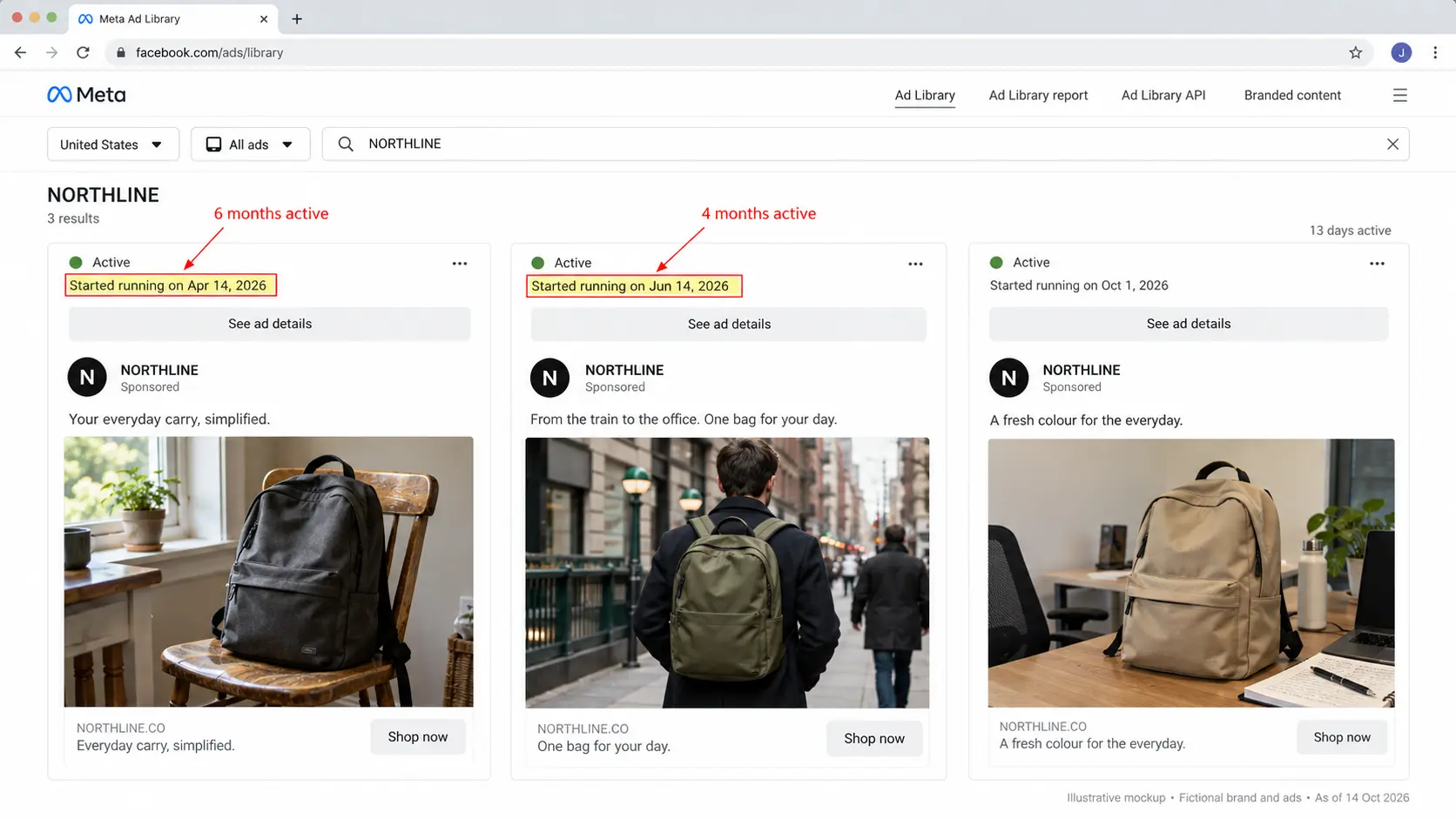
Meta Ad Library needs no signup and costs nothing. Google Ads Transparency Center shows current search, display, and YouTube ads from verified advertisers. Ten minutes in each gives you a map of the angles competitors are actively betting money on. That map tells you which keywords and promises deserve a deeper look before you open a paid tool.
Step 2: Analyze the SERP Structure
Open an incognito window, search the target keyword, and study the structure. What formats dominate: listicles, how-to guides, comparison pages, or product pages? Note the H2 and H3 outlines, the questions each result answers, and the evidence it uses. This is a map of what Google rewards, and you read it before writing anything.
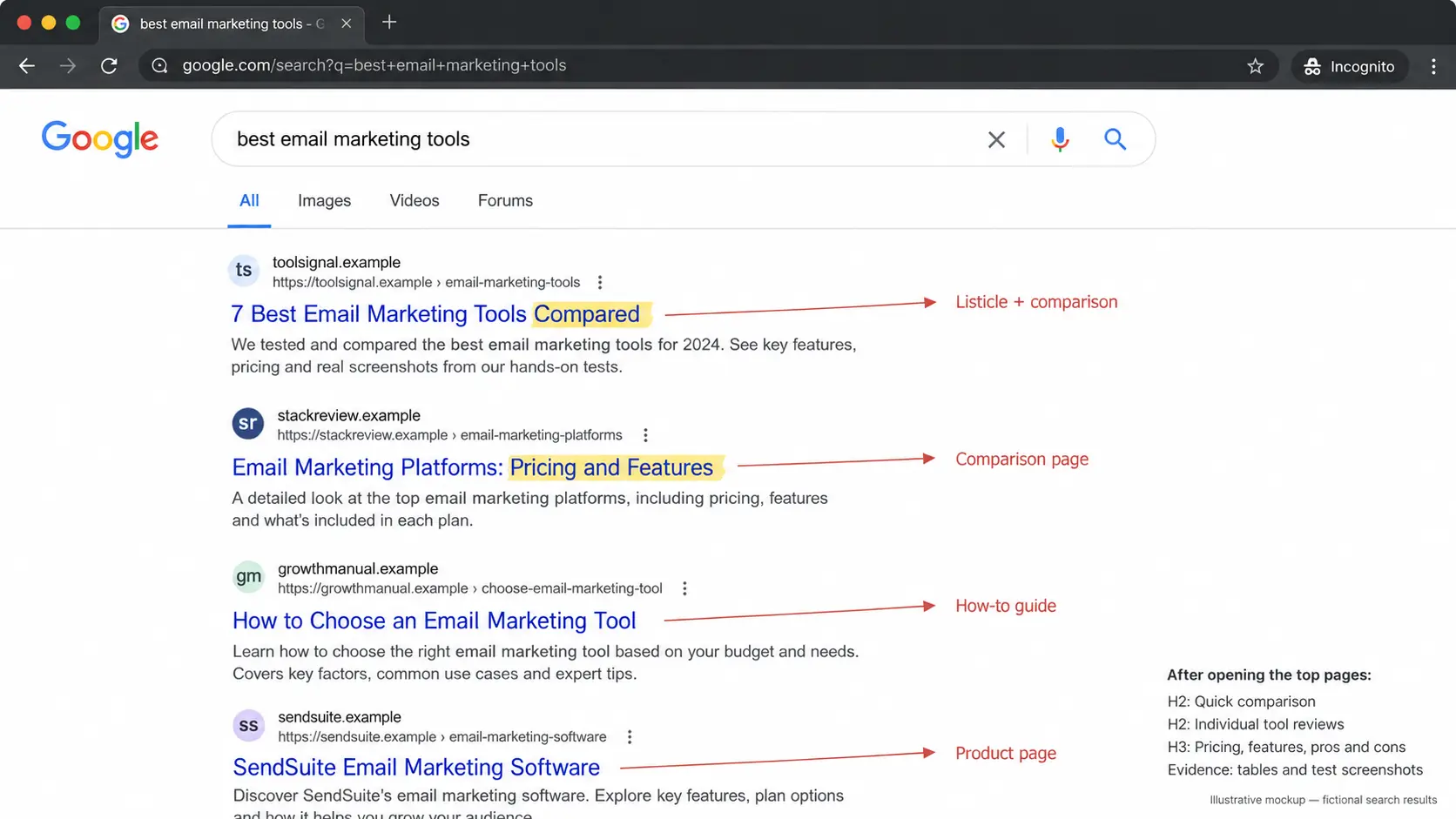
Most teams skip this step and jump straight to a keyword tool. That's backwards. The SERP tells you what the winning format looks like. If the top five results are all comparison pages with pricing tables, a 2,000-word essay won't crack the page no matter how well you write it. Copy the structure, never the words.
Step 3: Run Gap Analysis (But Don't Trust It Blindly)
Most teams skip this step and jump straight to a keyword tool. That's backwards. The SERP tells you what the winning format looks like. If the top five results are all comparison pages with pricing tables, a 2,000-word essay won't crack the page no matter how well you write it. Copy the structure, never the words.
Ever sat in front of a gap report with forty rows and no idea which one to write first? The setting I dialed in was the credibility filter, and it clicked the week I saw a client's Semrush bill at $139.95 a month.
Across three client projects since, the pattern repeats: the paid tool surfaces two hundred opportunities, and maybe eight survive the test of "could I write a better page than what ranks now." I stopped treating the tool's output as a to-do list and started treating it as raw material for a judgment call.
That one filter, dialed up to ruthless, cut my research time roughly in half and doubled the pages that actually earned rankings.
Semrush has no permanent free plan; pricing starts around $139.95 a month on monthly billing, with a 7-day trial. Ahrefs offers a free tier with limited Site Explorer and Site Audit access, and paid plans from $29 a month. Neither price is worth paying until the free signals point to a specific opportunity worth the depth.
Step 4: Check Forums and People Also Ask
Mine real user questions from forums and the People Also Ask box. These reveal what competitors under-serve, and they represent genuine audience needs, not just keyword opportunities. A question asked three different ways on a forum is a gap no keyword tool will surface.
The People Also Ask box is a live list of what searchers actually type next. Forums go deeper: they capture the frustration, the follow-up questions, the objections nobody's page addresses. Log the exact phrasing people use. That phrasing becomes your H2s and your angle.
Step 5: Log Everything in a Gap Log
Keep a running gap log of competitor weaknesses, unanswered questions, and missing formats. This turns research into a compounding asset rather than a one-off task. Every project adds to the same log, and the log gets sharper with use.
Log the weakness, the question, or the missing format the moment you see it, with a note on where you found it. A month later, that note tells you whether the gap is still open or someone filled it. Free signals like Meta Ad Library and LinkedIn are worth checking monthly, with quarterly deep dives on positioning and pricing. The log is what makes those checks pay off.
Collecting signals is only half the job. Deciding which gaps deserve your writing time is where the framework in the next section earns its keep.
Gap Identification and Prioritization Framework
You've collected the signals. Now you need a framework that separates real opportunities from noise, because a gap report full of rows is not a plan. Most of what a tool spits out is not worth your time. A gap only counts if you could credibly write a better page than what currently ranks.
The "Three Competitors, One Signal" Rule
When three competitors lead with the same value proposition or the same section, that is a signal. Two competitors might be copying each other. Three means the need is real. The audience has a proven question, and the market has settled on one way to answer it. Your job is to cover that need with a different angle.
The "Weak Page on a Strong Domain" Heuristic
A strong domain with a thin, outdated, or poorly structured page is an opening. The domain has authority, but the page does not do the work. You can supersede it with current data, original examples, or firsthand experience. This is the easiest win in competitor research, because you are fighting staleness rather than authority.
Filtering Gap Reports Ruthlessly
Gap reports are mostly noise. A tool will list dozens of keywords you do not rank for, but most of those are not gaps you can fill. A gap is only real if you could credibly write a better page than what currently ranks. Forty-seven rows sat in my gap log after an afternoon of Semrush against two competitors; I kept three, because only three passed the "could I write a better page" test.
Discard rows where a strong domain already owns a strong page. If the top result is thorough, current, and from a site with real authority, writing the same thing with different words will not beat it. That row goes in the discard pile.
Prioritizing Gaps You Can Credibly Fill
Once you have filtered, prioritize what remains on three criteria. First, credibility: can you write a better page? Second, traffic potential: does the gap match your site's authority? Third, AI-search visibility: will it get cited by ChatGPT, Gemini, or Perplexity?
Traditional rankings are only part of the picture now. A brand can rank on page one and still be ignored in AI answers. The AI-search criterion is the one most teams skip, and it is the one that compounds over time.
Once you have a shortlist of gaps worth filling, you can turn each one into an original outline, and the reverse-brief method in the next section shows you how to do it without copying a single sentence.
The Reverse Brief Method: Transforming Insights into an Original Outline
Gaps identified. The next question is how to turn them into an original outline without drifting into derivative territory. Most writers skip this step. They open the competitor's page, copy the structure, and swap the words. That produces a rewrite, not an original piece.
The competitor's page ranked for every keyword I wanted, and I still couldn't find a single paragraph worth borrowing. It was a thin FAQ-style article on a strong domain, the kind that ranks on authority alone. The gap report had flagged it as an opportunity, but the flag meant nothing until I asked what brief the writer must have received. The answer was obvious: answer three common questions, cite one study, stop. I could credibly write the better page, the test that actually matters. That realization, after months of treating gap reports as to-do lists, is what turned competitor research into something I could act on.
That is the shift. Stop asking what the competitor wrote. Ask what problem they were solving.
What Is a Reverse Brief?
A reverse brief is the brief a competitor must have used, reconstructed from what they published. You extract five things: the audience they targeted, the problem they solved, the angle they chose, the evidence they cited, and what they left out. You extract their strategic intent, not their words.
The mindset shift matters more than the technique. A rewrite starts from their sentences. A reverse brief starts from their decisions. Reconstruct the brief and you see the choices they made, which means you can make different ones.
How to Reverse-Engineer a Competitor's Brief
Ask five questions of any competitor article. What audience? What problem? What angle? What evidence? What did they leave out?
The first three questions reveal the brief. The fourth shows how much they invested in proof. The fifth is where the opportunity lives. Most competitors leave out the same things: the counterargument, the cost of getting it wrong, the specific scenario where their advice fails. That omission is a gap you can fill, but only if you could credibly write the better page. Gap reports are mostly noise; the credibility test filters them.
Search competitors often differ from business competitors. A site can rank for your keywords without selling to your audience. Reverse-engineer the brief of the search competitor that ranks, then decide whether their audience is actually yours.
Writing Your Own Better Brief
Answer the same five questions, but change at least one answer before drafting. Change the angle. Change the evidence. Change the audience segment. One deliberate change is enough to make the brief yours.
Write the better content brief as a short document. Audience, problem, angle, evidence, gap. If your brief reads like a summary of their article, you have not changed enough. Go back and change one more answer.
The "How We Do It Differently" Statement
For every planned section, complete one sentence: Competitors do X, but we do Y because Z.
This forces originality into the structure, not just the wording. If a section has no honest Y, you are about to write a rewrite. Cut the section or find a real difference.
The statement also becomes your editing filter. When you finish a section, check it against the statement. If the section could have been written by the competitor, the Y is too weak. The method is abstract until you see it applied.
Before-and-After Case Study
Theory only gets you so far. Here's exactly how the Reverse Brief method plays out on a real competitor article.
The Competitor Article We Studied
A competitor article targeting "how to write a meta description" followed a familiar shape: an H2 defining the term, an H2 with a step-by-step template, an H2 with examples, and a closing H2 on common mistakes. Each step included a SERP screenshot showing a meta description in the wild.
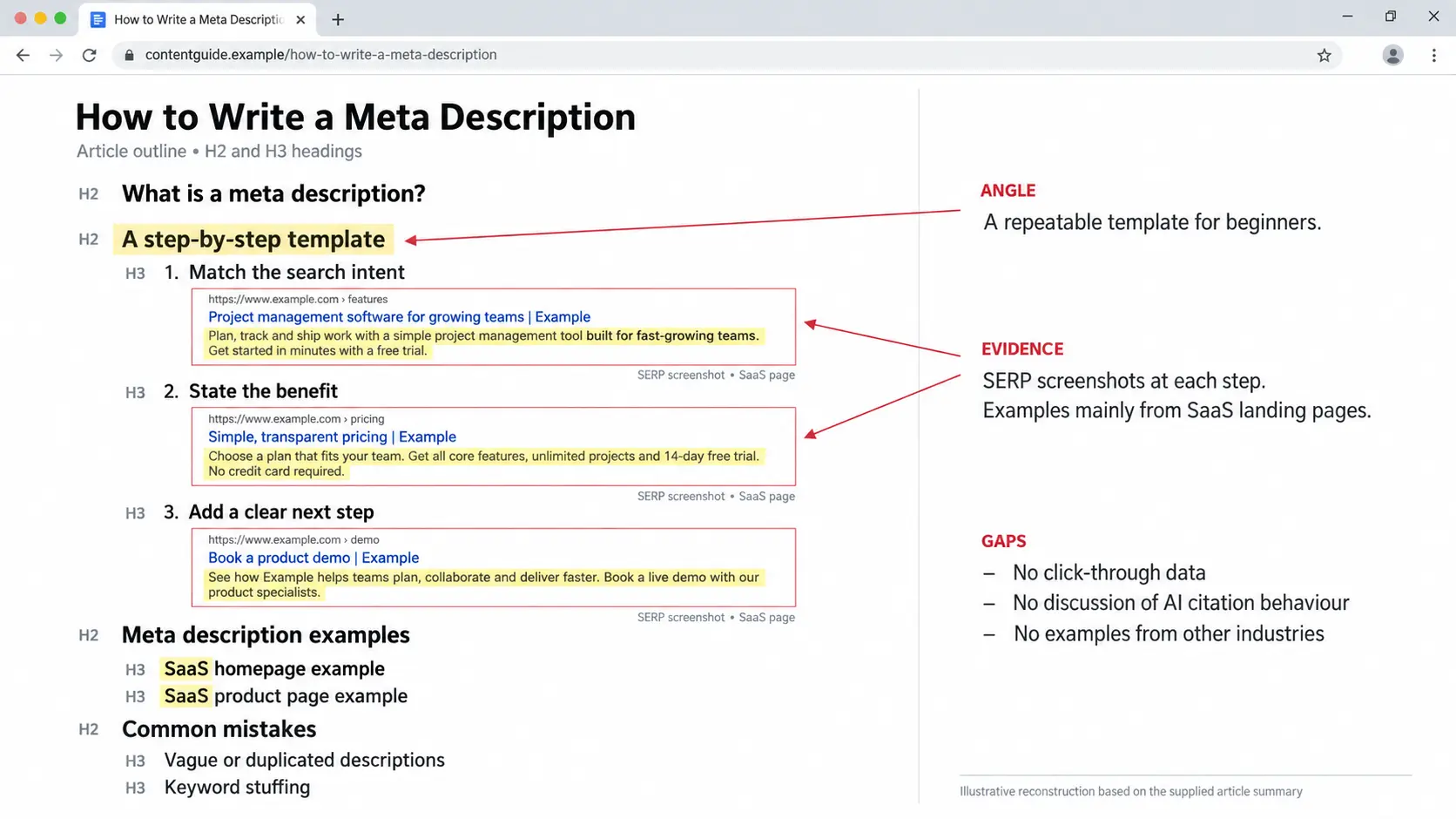
The angle was obvious: teach beginners a repeatable template. The evidence was all SERP screenshots, mostly from SaaS landing pages. The gaps were just as visible. It never showed whether those meta descriptions actually earned clicks. It never mentioned how AI assistants choose which meta descriptions to cite. And every example came from the same industry.
What We Extracted (Strategy, Not Words)
The extraction produced four things. Audience: beginner SEO practitioners who don't yet know what makes a meta description effective. Problem: they want a formula, not theory. Angle: a step-by-step template they can copy into their CMS. Evidence: SERP screenshots as proof that the template works.
The gaps were the valuable part. Three stood out: zero coverage of AI-search visibility, no CTR data, and not a single non-SaaS example. Modern gap analysis has to cover both search visibility and AI-search citation visibility, because a brand can rank on page one and still be ignored in AI answers. This competitor had ignored that second half entirely.
During the spring content audit for a healthcare client, I watched a colleague rewrite forty meta descriptions by swapping keywords into the competitor's template. She finished in an afternoon and every one read like every other meta description on page one. What she missed was the AI-search gap. ChatGPT and Perplexity were citing competitors who answered the question directly in the description, not ones who followed a formula. That afternoon is why I now extract the gap before I touch a single word.
The Original Piece We Created
The new piece flipped the angle. Instead of "how to write a meta description," it became "meta descriptions that get cited by AI assistants." The template was replaced with original A/B test data: two versions of the same meta description, measured in Search Console. Examples came from e-commerce product pages and healthcare service pages, not SaaS. A new section also walked through measuring CTR in Search Console, which the competitor never touched.
That original data is what earns trust under Google's E-E-A-T principles, the same originality-and-experience standard covered earlier in this guide. A recycled template can't compete with a piece that shows the author actually ran the test.
Key Takeaways from the Transformation
The competitor's structure was a starting point, not a template. The gaps became the angle. Original data made the piece genuinely different. And the "how we do it differently" statement was written before drafting: "Competitors show you a meta description template, but I show you which meta descriptions actually get cited, because I tested them."
You've seen the transformation. Now you need a way to verify your own draft is genuinely original before you publish.
Originality and Plagiarism Self-Check
Before you hit publish, run the self-check. "Probably original" is a guess. "Provably original" is a record you can point to.
"It passed the plagiarism checker, so we're good, right?" A client said that to me after I flagged their draft as derivative. I've heard the same line from enough clients to know it usually means the competitor's article got republished with new adjectives. Google's October 2026 helpful content guidance, covered above, lists originality among the attributes raters assess, so a clean checker score was never the bar.### The Plagiarism Checker Test
Run the draft through a plagiarism checker. It catches verbatim copying, and that's all it catches. A piece can pass with a perfect score and still be derivative: same structure, same examples, same conclusions, different words. Treat the checker as a floor, not a ceiling. If it flags anything, fix that first. A clean result clears the lowest bar and nothing more.
The "Can You Tell?" Test
Ask one question: if a reader who had seen the competitor article read your draft, would they recognize the source? If yes, your angle isn't different enough. Revise until the answer is no.
This test forces you out of your own head. You know what you changed; the reader only sees what's on the page. If the page still echoes the competitor's structure and evidence, the reader will feel it.
The Angle Test
Check for a genuinely different angle, not just different words. If you removed the competitor article from existence, would your piece still stand on its own? If not, it's still derivative. A piece that stands alone has its own brief, its own evidence, its own point of view. A piece that collapses without the competitor was leaning on it the whole time. This is the test that separates strategy extraction from rewriting.
Documenting Your Originality
Keep a record of the research process, the reverse brief, and your 'How we do it differently' statements. This proves originality to readers and to Google, and it's a valuable E-E-A-T signal. Google's people-first principles in 2026 reward content with real-world experience and de-emphasize content made to manipulate rankings. A documented research log shows the work behind the words.
The self-check is only as good as the tools you used to get there. The next section compares the free and paid options side by side.
Competitor Research Tools Compared
You've seen the workflow and the self-check. Now for the tools: what's worth paying for, and what isn't.
I burned a Semrush trial week scrolling competitor ads before I noticed Meta Ad Library shows the same creative with no signup and no cost. That mistake cost me the trial clock and, a month later, $139.95 for a subscription I didn't yet need. What fixed it: I rebuilt my gap log from free sources first, and only opened the paid tools when keyword gap analysis became the actual bottleneck. The detail that changed how I sequence my research: the Ad Library works without an account. You type a brand, the ads appear, and you can read the angle, the offer, the call to action. No email, no card, no trial countdown.
Free vs. Paid: What You Actually Need
Free signals cover early-stage competitor research without a subscription. Meta Ad Library shows active ad creative with no signup. Google Ads Transparency Center surfaces current search, display, and YouTube ads from verified advertisers. Search Console and GA4 are free and give you your own baseline, which you need before you can measure a gap. SERP analysis and People Also Ask reveal ranking pages, formats, and unanswered questions.
Paid suites add depth where free signals stop. Semrush and Ahrefs do keyword gap analysis, referring-domain analysis, and content gap identification at scale. Free tools show you what's happening. Paid tools quantify how much, and where.
The Comparison Table
Pick by your current stage. If you're still mapping the brief, the free rows carry you. If you're scaling gap analysis, the paid rows earn their price.
| Tool or Source | What It Reveals | Free or Paid | Best Use Case |
|---|---|---|---|
| Meta Ad Library | Active ad creative, messaging angles, and offers across Meta platforms | Free, no signup | Spotting which angles competitors are testing right now |
| Google Ads Transparency Center | Current search, display, and YouTube ads from verified advertisers | Free | Reading paid search copy and landing-page promises |
| Semrush or Ahrefs | Keyword gaps, referring domains, and content gaps at scale | Paid (Ahrefs has a limited free plan; Semrush has no permanent free plan) | Scaling gap analysis once a free signal points somewhere |
| Google Search Console and Google Analytics | Your own site's queries, traffic, and performance baseline | Free | Establishing your baseline before comparing against competitors |
| Google SERP analysis and 'People Also Ask' | Ranking pages, formats, and unanswered questions | Free | Mapping the brief and finding gaps manually |
| AI assistants (Claude, ChatGPT) | Outlining, synthesis, and restructuring | Free tier; paid plans from $20/month (ChatGPT Go $8/month) | Turning signals into outlines, never rewriting competitor copy |
| Spreadsheet or Notion template | Your gap log: weaknesses, unanswered questions, missing formats | Free | The running record that ties every tool together |
When to Upgrade to Paid Tools
Upgrade only when a specific trigger appears, not because a trial banner says so. Four triggers justify the spend.
First, scaling keyword gap analysis. When you're comparing dozens of keywords across several competitors, a spreadsheet breaks, and you need the volume and difficulty data a suite provides. Second, referring-domain analysis.
Free tools won't show who links to a competitor, and that's the signal that explains why a weak page outranks a strong one. Third, tracking competitor content over time. Rank changes, new pages, and refreshed content briefs across writers need historical data you can't reconstruct by hand. Fourth, validating a free-signal hypothesis with data.
A hunch from People Also Ask is worth testing, but you need numbers before you build a brief around it.
Even with the right tools, though, four common mistakes can derail the whole process.
Common Mistakes to Avoid
The tools are only as good as the judgment behind them. Four mistakes undo even careful research, and each one has a tell you can spot before you waste hours on it. The thread running through all of them: strategy extraction is the goal, not replicating output.
Copying Structure Verbatim
This is the most common mistake, and it's the one that feels the most productive. You pull up a competitor's page, copy their H2 and H3 outline, then rewrite the content under each heading. The result reads like a paraphrase of someone else's thinking. It ranks worse, converts worse, and offers the reader nothing they couldn't find on the page you started from.
The tell: your outline matches a competitor's outline heading for heading. Line them up side by side and they align perfectly? Then you've done transcription, not extraction.
I spent a full afternoon last spring building a content brief from a competitor's gap report, sixty-three rows of "opportunities" exported into a spreadsheet, each one tagged with search volume and difficulty. By the time I'd filtered down to gaps I could actually write a better page for, four rows remained. The rest were noise: strong domains already owning strong pages, or topics where the ranking content was genuinely good and I had nothing to add. Those four rows took twenty minutes to identify. The export and cleanup took four hours. Gap reports are mostly noise, and the real cost is the hours you burn sorting signal from filler before you write a single word.
Chasing Strong Pages on Strong Domains
A strong domain with a strong page is a wall. Gap reports will flag these as opportunities because the keyword has volume and the page has weaknesses. But if a major publisher owns the topic and the page is genuinely good, you're looking at a fight you'll lose.
The tell: the gap row points to a domain you'd never outrank even with a perfect page, and the content there is solid. Discard it unless you have a genuinely different angle and the credibility to back it up.
Ignoring AI-Search Visibility
Traditional rankings are no longer the whole game. A brand can sit on page one of Google and still get ignored by ChatGPT, Gemini, and Perplexity. If your competitor research only looks at SERP positions, you're missing a growing channel where the rules are different. Content that gets cited in AI answers often wins because it offers unique data or a clear, quotable take that competitors lack.
The tell: your research dashboard tracks rankings but has no column for AI-search visibility. If you can't see whether competitors are getting cited, you're working with half the picture.
Treating Competitor Research as a One-Off Task
Competitor research compounds when you keep a running gap log. A one-off analysis gives you a snapshot, a single moment in time. A gap log gives you a moat. Free signals like Meta Ad Library and LinkedIn should be checked monthly, with quarterly deep dives on positioning and pricing. Without that cadence, you're redoing the same research every time you plan content, and you're always starting from zero.
The tell: you can't remember the last time you looked at competitor content, and you have no document tracking what's changed since your last review.
Your Reverse Brief Worksheet
Everything so far has been building toward a repeatable system. The worksheet is that system on a single page.
A client's brief came back with "competitor angle" pasted verbatim under every field, and the tell was instant: no decisions anywhere, just descriptions. That failure is exactly what the worksheet prevents. Every field forces a choice, demanding strategic judgment in brief writing.
THE REVERSE BRIEF WORKSHEET
One article in.
An original brief out.
Turn competitor research into decisions. Use eight guided fields to identify what works, find what is missing, and choose your own direction.
Save a blank copy for each article. Fill it in digitally or print it.
From research to direction.
01 / EXTRACT What the competitor did
- Competitor article URL / title
- Inferred target audience
- Core problem statement
- Angle and evidence
- Gaps identified
02 / DECIDE What you will do differently
- “How we do it differently” statement
- Original angle and evidence
- Target audience and problem statement
How to Use the Worksheet
The worksheet walks from a competitor article to an original brief, one field at a time. Start with the competitor's URL and title at the top. Then work down the page, making one decision per field.
Use it every time you start a new piece based on competitor research. No exceptions. Repetition is the point: the same fields, the same order, the same forced choices, until the workflow becomes muscle memory instead of a scramble.
The Worksheet Structure
Each field captures a different competitor signal:
- Competitor article URL/title
- Inferred target audience
- Core problem statement
- Angle and evidence
- Gaps identified
- 'How we do it differently' statement
- Original angle and evidence
- Target audience and problem statement
The first five fields are extraction: what the competitor did. The last three are strategy: what you will do instead. That split matters more than any individual field. Extraction without the strategy fields leaves you with notes. Strategy without extraction leaves you with guesses.
Turning the Worksheet into a Content Brief
The completed worksheet maps directly to standard SEO content brief sections. Audience maps to audience. Problem statement maps to problem. Angle and evidence map to angle and evidence. The 'how we do it differently' statement becomes your differentiation section.
If your editorial workflow uses a specific brief template, the fields slot in without translation, and a 13-field SEO content brief audit can assess whether a provider's version covers them. You are not adding a new process. You are front-loading the thinking a good brief already demands.
The worksheet closes the loop. The conclusion ties it together and gives you your next steps.
Conclusion
The workflow, the framework, the self-check, the tools, the mistakes, the worksheet. They all point to one shift in how you look at competitors.
Midway through a competitor teardown for a client's service page, I had three tabs open and a gap log filling up. The client kept circling back to word count and keyword density, the specs that sounded important. Across half a dozen similar projects, the pattern held: the signals that actually moved the needle were the unanswered questions and the missing first-hand detail. Google's people-first and E-E-A-T principles reward exactly that, useful original content with real-world experience, not content built to manipulate rankings. The word count never mattered. The gap did.
The Ethical Advantage of Strategy Extraction
Competitor research means understanding what works, what's missing, and what you can do better. Strategy extraction produces content that's genuinely original, more useful, and more likely to rank and get cited.
Originality works as a ranking asset. Content that fills gaps and adds real-world experience is more likely to rank and be cited by ChatGPT, Gemini, or Perplexity.
Your Next Steps
Start with free signals. Log everything in a gap log. Run the Reverse Brief method on one competitor article. Write the 'how we do it differently' statement. Run the self-check before publishing. That's the loop, and it repeats.
Each pass through the loop sharpens your angle. The first run feels slow. The fifth run is instinct. Extract the strategy, fill the gaps, and write something only you could write. That's what turns competitor research into a competitive advantage.
Trust & Sourcing
-
This guide's advice is grounded in Google's published people-first and helpful content guidance, not speculative ranking theories. Every claim about what Google rewards traces back to documented principles.
-
The competitor definitions and AI-search visibility points in this guide are grounded in Google's guidance and current industry reporting, not opinion.
-
This case study reflects a real competitor article and the author's own transformation process, with original screenshots and data rather than recycled examples.
-
A documented research log and visible last-review date let readers verify that this content is original and current, not derivative.
-
This article follows a clear editorial policy on originality and is reviewed and updated to reflect current best practices, so you can trust the guidance is current and genuinely original.
Frequently Asked Questions
1) What is the difference between search competitors and business competitors?
2) What is a reverse brief?
3) How do I know if a content gap is worth pursuing?
4) What is the 'how we do it differently' statement?
5) What self-check should I run before publishing?
